
What Happens in Our Brains When Viagra Meets Alcohol?
Authors: Jennifer Doudna, Emmanuelle Charpentier
Introduction
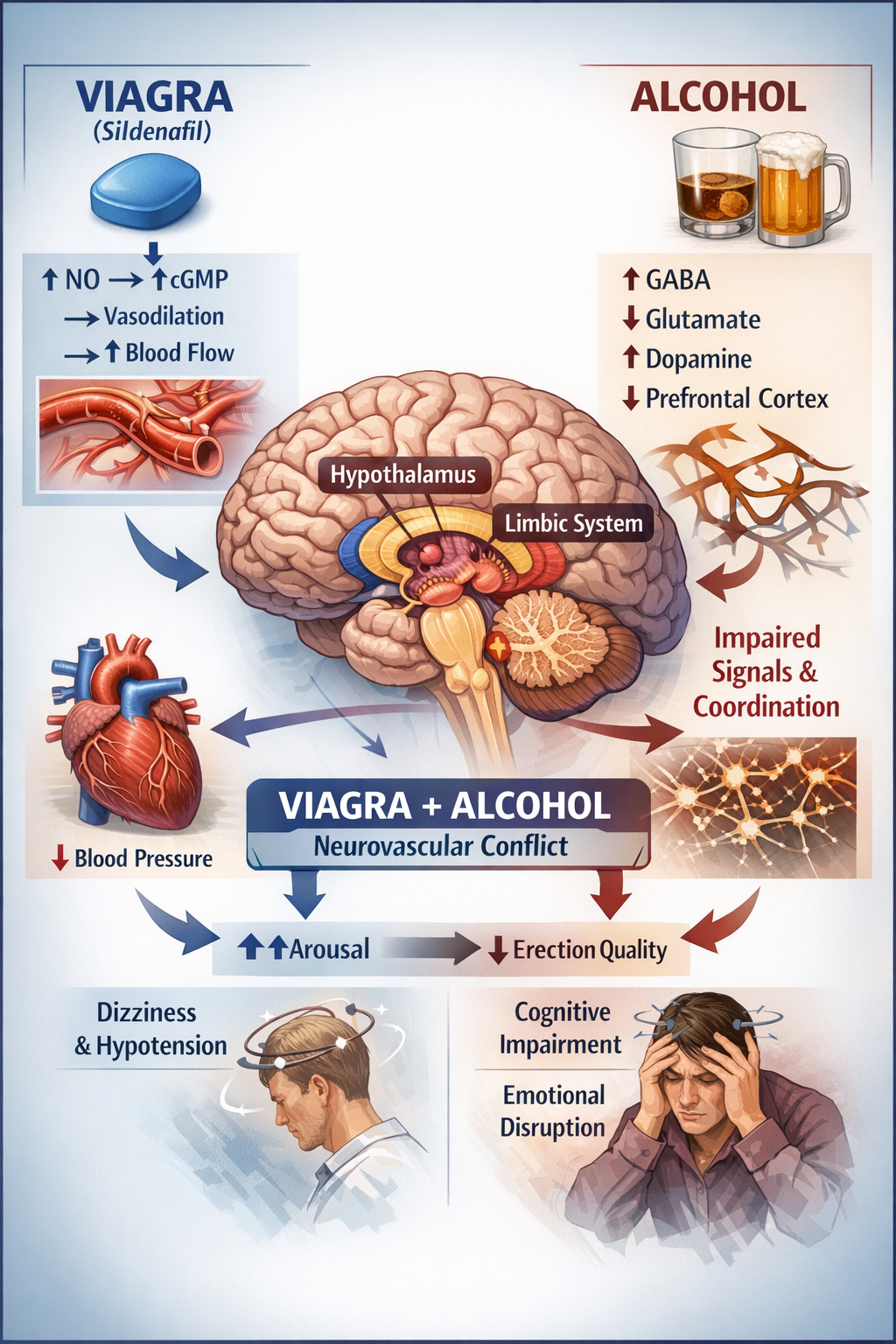 The combination of Viagra and alcohol is common, socially normalized, and frequently misunderstood. Sildenafil is often perceived as a purely peripheral drug that “works below the waist,” while alcohol is treated as a mild social lubricant rather than a potent psychoactive substance. In reality, both act on interconnected neurovascular systems that link the brain, autonomic nervous system, and sexual response. When taken together, they can create a physiological and psychological mismatch: subjective arousal may increase, while neural coordination, vascular stability, and erectile reliability deteriorate. Understanding what happens in the brain, and not only in the penile vasculature, is essential for explaining why this combination sometimes disappoints, sometimes destabilizes, and occasionally becomes medically relevant rather than merely inconvenient.
Viagra’s mechanism of action: from nitric oxide to brain–body signaling
Viagra (sildenafil) was developed as a selective inhibitor of phosphodiesterase type 5 (PDE5), an enzyme responsible for breaking down cyclic guanosine monophosphate (cGMP). During sexual stimulation, nitric oxide (NO) is released from endothelial cells and nitrergic neurons, activating guanylate cyclase and increasing cGMP levels. Elevated cGMP causes smooth muscle relaxation in the corpora cavernosa, leading to increased blood inflow and erection. By inhibiting PDE5, sildenafil prolongs this signal, but only when the upstream processes of arousal and NO release are already active. Crucially, this means Viagra does not initiate sexual desire. Libido, motivation, and arousal originate in the central nervous system, particularly within hypothalamic and limbic circuits. Sildenafil acts downstream, amplifying a peripheral response that depends on intact neural signaling from the brain through the spinal cord and autonomic nerves. This dependency is often overlooked in popular discourse.
Although sildenafil is not classified as a psychoactive drug, it is capable of crossing the blood–brain barrier in small amounts. Experimental and clinical studies suggest that PDE enzymes and NO–cGMP signaling pathways are present in several brain regions involved in emotion, cognition, and autonomic regulation. While these central effects are subtle compared with classic psychotropic drugs, they may influence cerebral blood flow, autonomic tone, and the integration of sensory and emotional components of sexual experience.
From a systems perspective, Viagra operates at the intersection of vascular physiology and neural control. It enhances responsiveness, not intent. Any substance such as alcohol that interferes with attention, autonomic balance, or neurovascular coordination can therefore undermine the very conditions sildenafil requires to work effectively.
Alcohol and the brain: neurotransmitters, arousal, and cognitive control
Alcohol is a central nervous system depressant with paradoxical effects that depend on dose, context, and individual neurobiology. At low to moderate doses, it often produces subjective disinhibition, i.e., a feeling of relaxation, sociability, and increased sexual confidence. Neurochemically, this effect is driven by alcohol’s simultaneous action on multiple neurotransmitter systems rather than a single receptor.
The most prominent mechanism is enhancement of GABAergic signaling. Alcohol increases the inhibitory effect of gamma-aminobutyric acid (GABA), which suppresses neuronal firing across cortical and subcortical regions. This contributes to reduced anxiety and social inhibition but also impairs fine motor control and attentional focus. In parallel, alcohol inhibits glutamatergic transmission, particularly via NMDA receptors, disrupting learning, working memory, and executive functions. Alcohol also affects dopaminergic reward pathways, especially in the mesolimbic system. Increased dopamine release in the nucleus accumbens reinforces drinking behavior and can amplify perceived desire and motivation, including sexual interest. However, this dopamine-driven “wanting” is poorly regulated when prefrontal cortical control is dampened by GABAergic sedation.
From a sexual-response perspective, this creates a split effect. Desire and subjective arousal may rise, while the neural coordination required for sustained erection declines. Alcohol further alters serotonin and noradrenaline balance, which can blunt sensory feedback and delay or disrupt sexual performance.
Importantly, alcohol also impairs autonomic nervous system regulation. Parasympathetic activity, which is essential for erection, may be inconsistently activated, while sympathetic tone fluctuates. This instability becomes particularly relevant when alcohol is combined with drugs like sildenafil that depend on precise neurovascular timing rather than sheer vasodilation alone.
When Viagra and alcohol interact: neurovascular and chemical convergence
When Viagra and alcohol are taken together, their interaction is best understood as a convergence of vascular effects and disrupted neural regulation, rather than a simple drug–drug reaction. Both substances independently influence blood vessels, autonomic tone, and cerebral processing, but they do so in ways that can conflict rather than reinforce each other.
From a vascular standpoint, both sildenafil and alcohol promote vasodilation. Sildenafil does this selectively through the NO–cGMP pathway, primarily in erectile tissue but also systemically to a mild degree. Alcohol, by contrast, induces more diffuse vasodilation through central and peripheral mechanisms, including inhibition of vasomotor centers and direct effects on vascular smooth muscle. When combined, these effects can lead to additive reductions in blood pressure, particularly in upright positions, increasing the risk of dizziness, lightheadedness, or transient cerebral hypoperfusion.
At the neurobiological level, the interaction becomes more complex. Sildenafil requires a coherent parasympathetic signal originating in the brain and spinal cord to translate sexual arousal into a vascular response. Alcohol interferes precisely at this level by impairing attentional focus, sensory integration, and autonomic coordination. The brain may register desire and emotional readiness, while the downstream neural signals needed to sustain erection become fragmented or delayed. This creates a characteristic mismatch: subjective arousal without reliable physiological execution. Dopaminergic reward circuits may signal heightened interest, while GABA-mediated inhibition suppresses cortical and brainstem coordination. The result is not simply erectile failure, but variability: erections that are short-lived, poorly sustained, or inconsistent despite sildenafil being pharmacologically active.
Cerebral blood flow regulation may also be affected. NO signaling plays a role in neurovascular coupling, the process by which active brain regions receive increased blood supply. Alcohol disrupts this coupling, and sildenafil may further modify vascular responsiveness. Although these effects are subtle in healthy individuals, they can contribute to altered perception, slowed reaction time, and impaired situational awareness during sexual activity.
In practical terms, Viagra does not “override” alcohol’s neural effects. Instead, alcohol reshapes the internal environment in which sildenafil must operate, often making its outcomes less predictable and less reliable, despite adequate dosing.
Brain regions and neurotransmitters involved in arousal and erection
Sexual arousal and erection are coordinated by a distributed brain network, not a single center. At its core is the hypothalamus, which integrates hormonal signals, sensory input, and emotional context. Within this region, nuclei such as the medial preoptic area play a central role in initiating sexual responses and activating downstream autonomic pathways that ultimately influence penile blood flow.
The limbic system, including the amygdala and nucleus accumbens, contributes the motivational and emotional components of sexual desire. Dopamine is the key neurotransmitter here, reinforcing anticipation and reward. Alcohol tends to amplify dopaminergic signaling in these circuits, increasing perceived desire, while simultaneously dulling the brain’s capacity to translate motivation into coordinated action.
The prefrontal cortex provides top-down regulation, dealing with attention, judgment, and inhibition. It helps interpret cues, assess safety, and maintain focus on erotic stimuli. Alcohol suppresses prefrontal activity, weakening cognitive control and impairing the integration of sensory feedback. This can distort perception of arousal and exaggerate confidence without improving physiological readiness.
At the level of neurotransmitters, dopamine, serotonin, noradrenaline, and nitric oxide form a dynamic balance. Dopamine promotes desire, serotonin modulates timing and satisfaction, and noradrenaline influences alertness and sympathetic tone. Nitric oxide acts as a crucial messenger linking neural activation to vascular response. Alcohol disrupts this balance, while sildenafil selectively enhances NO-dependent signaling in peripheral tissue.
The combined effect is often a disconnection between brain-generated arousal and bodily response, especially when alcohol-induced neural noise interferes with the precise signaling erection requires.
Risks, side effects, and psychoemotional consequences
The interaction between Viagra and alcohol rarely produces dramatic toxicity in healthy individuals, but it does increase the likelihood of clinically relevant side effects particularly those involving the brain and autonomic nervous system. The most common risk is hypotension, resulting from additive vasodilatory effects. This can manifest as dizziness, blurred vision, headache, or near-syncope, especially when standing or during physical exertion.
From a neurocognitive perspective, alcohol-related impairment of memory formation and perception is a key concern. Even moderate alcohol intake can disrupt hippocampal function, leading to fragmented recall of sexual encounters. When combined with sildenafil, often used in emotionally charged or performance-focused situations, this can amplify anxiety, disappointment, or misinterpretation of events afterward. The psychoemotional effects are equally relevant. Alcohol reduces inhibitory control while dulling emotional nuance, increasing the risk of overconfidence, impulsivity, and misjudgment. This can lead to unrealistic expectations of Viagra’s effects, riskier sexual behavior, or difficulty accurately perceiving a partner’s responses and boundaries. Sildenafil does not correct these distortions and may indirectly reinforce them by signaling “readiness” that the brain is not fully prepared to manage.
In some individuals, the combination may provoke paradoxical reactions, such as heightened anxiety, irritability, or emotional blunting when the expected sexual outcome does not occur. These experiences can negatively affect self-esteem and future sexual confidence, particularly if repeated.
Overall, the risks are less about acute danger and more about predictability, safety, and psychological aftermath.
Conclusion
When Viagra and alcohol meet in the brain, the result is not synergy but tension. Sildenafil enhances a vascular process that depends on precise neural coordination, while alcohol disrupts the very systems responsible for attention, autonomic balance, and judgment. The outcome is often a mismatch between desire and performance, confidence and control. Understanding this interaction reframes the issue: Viagra does not counteract alcohol’s neural effects, and alcohol does not make Viagra work better. Moderation and timing remain the most effective tools for reducing risk and improving sexual outcomes.
References
- Oscar-Berman, M., & Marinković, K. (2007). Alcohol: Effects on neurobehavioral functions and the brain. Neuropsychology Review, 17(3), 239–257.
https://doi.org/10.1007/s11065-007-9038-6 - Glossmann, H., & Petrischor, G. (1999). Molecular mechanisms of the effects of sildenafil (Viagra®). Experimental Gerontology, 34(3), 305–318.
https://doi.org/10.1016/S0531-5565(99)00003-0 - Generic Viagra (Sildenafil) Online: Prices, Safe Buying, and Best Options (USA)
- Sildenafil 100 mg: Psychophysiological Profile & Role in SSRI-Induced Sexual Dysfunction
- Risk-Taking and Recreational Viagra: Emerging 2024 Public-Health Warnings