
How Much Does Therapy Cost? Rates, Sliding Scale, and ROI of Care
Introduction
Therapy’s return on investment can be substantial.The cost of therapy is one of the most common barriers between people and the help they need. Online directories list hundreds of providers, yet few publish their rates openly. Even within a single city, prices can swing from $60 a session at a community clinic to over $300 in private practice before insurance enters the equation.
Part of the confusion comes from the fact that therapy isn’t a single product. Costs vary by training level, therapy style, and setting. Cognitive Behavioral Therapy (CBT), psychodynamic psychotherapy, EMDR, and couples counseling all differ in duration, structure, and overhead. Telehealth platforms, while more affordable, may limit continuity or depth. Still, therapy’s return on investment can be substantial. Evidence shows that consistent, structured treatment not only improves mood and relationships but also reduces workplace absenteeism, healthcare costs, and chronic stress–related illness.
This article maps the financial and practical terrain of psychotherapy: what drives rates, how to use insurance or tax-advantaged accounts, how to preserve outcomes when money is tight, and how to choose a therapist strategically within your means.
Typical Ranges by Modality & Setting
Therapy pricing depends less on a single factor than on a matrix of variables — the provider’s training, the therapeutic model, the setting, and the local cost of living. Therapy pricing depends less on a single factor than on a matrix of variables — the provider’s training, the therapeutic model, the setting, and the local cost of living. Understanding these levers helps estimate what “reasonable” means for your situation.
Brief, structured therapies such as CBT consistently show high returns on investment, improving not only emotional well-being but also productivity, physical health, and interpersonal functioning. Even limited or intermittent care, when guided by clear goals and data, can offer durable results. The key is transparency: know your rates, track your progress, and plan for financial sustainability as you would for physical fitness or medication.
Therapy isn’t just about cost; it’s about value. A well-planned short-term program can often deliver more value than months of unfocused conversation. Knowing what each modality offers allows you to match both your goals and your budget — the first step toward sustainable mental healthcare.
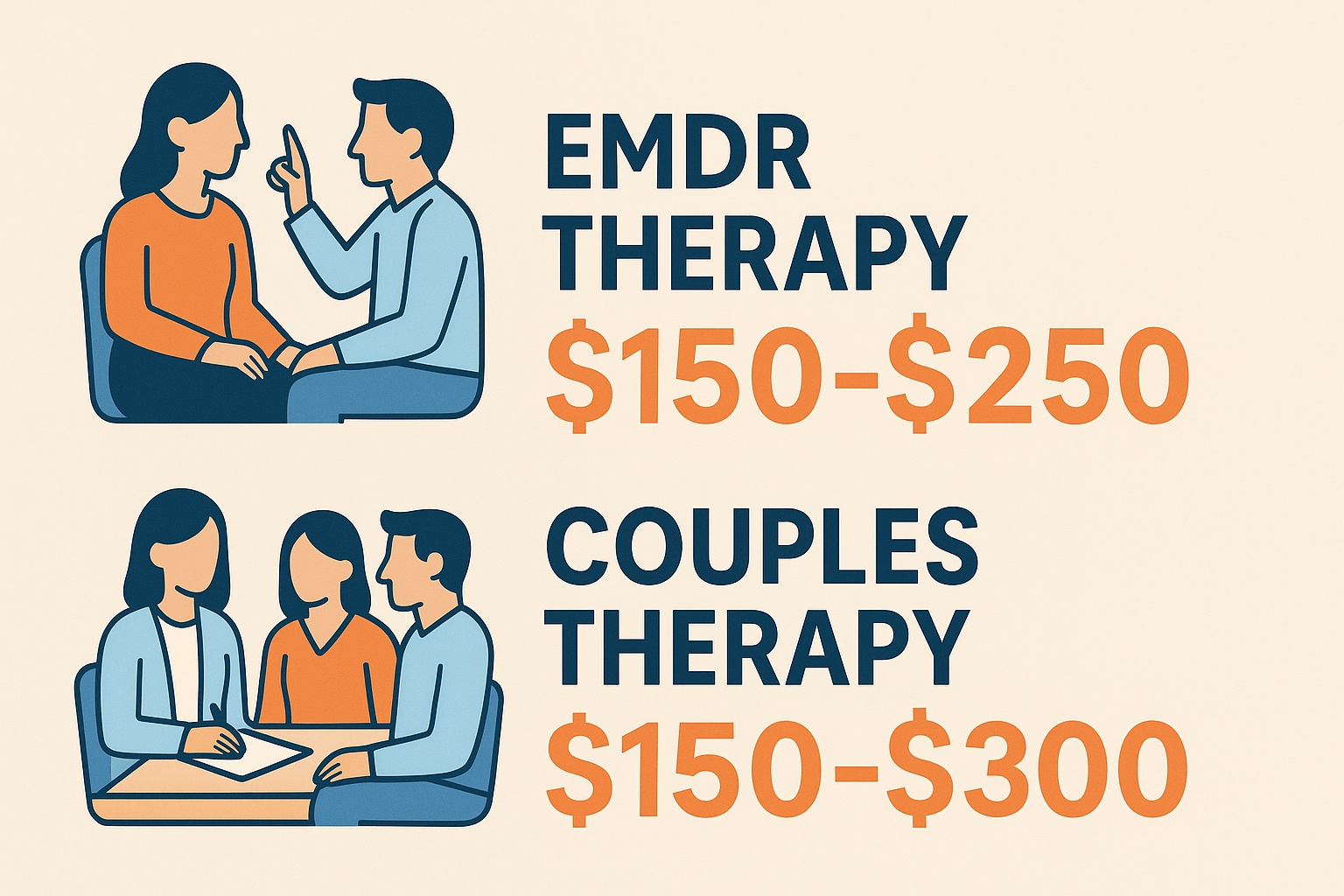 Desensitization and Reprocessing) , used primarily for trauma, costs around $150–$250 per 60–90-minute session, especially with certified specialists. Couples and family therapy tends to fall between $150 and $300 per session and is rarely covered by insurance because it doesn’t fit neatly into diagnostic billing codes. The setting makes a large difference.
- Private practices offer maximum scheduling flexibility and confidentiality, but charge the highest rates.
- Community mental health clinics and university training centers (where licensed clinicians supervise graduate interns) may charge $40–$100 per session based on income, often with sliding scale or grant-funded support.
- Telehealth sessions typically run 10–25% cheaper than in-office visits, reflecting lower overhead for both therapist and client.
- Group therapy offers another cost-effective option, averaging $40–$80 per session. Groups based on CBT or dialectical behavior therapy (DBT) frameworks can teach practical skills while lowering costs.
Frequency also shapes total expense. Weekly sessions are standard during the active phase of treatment, tapering to biweekly or monthly maintenance once progress stabilizes. Over a year, even a modest $150 weekly rate adds up to nearly $7,800, which is a significant outlay that underscores the importance of structured, time-limited care when possible.
Insurance, Superbills, HSAs/FSAs
Understanding the mechanics of billing helps you plan realistically — and claim every dollar you’re entitled to. The financial side of therapy is often as confusing as the emotional one. Two patients seeing equally qualified therapists may pay drastically different amounts, depending on whether the provider is in-network, out-of-network, or private-pay only.
In-network care is the most straightforward: you pay a fixed copay or coinsurance after meeting your deductible, and the therapist bills your insurer directly. The trade-off is choice. Many high-demand specialists don’t join insurance panels because reimbursement rates are low and administrative work is heavy.
If your preferred therapist is out-of-network (OON), you typically pay upfront and submit a superbill for partial reimbursement. This document lists key identifiers, such as the therapist’s National Provider Identifier (NPI), your diagnosis code (ICD-10), procedure code (CPT, usually 90834 or 90837 for individual sessions), and session date. Most insurers reimburse 50–80% of “reasonable and customary rates once your OON deductible is met. Some states require parity laws, meaning telehealth therapy must be covered at the same rate as in-person sessions.
Since claims take time, it’s wise to keep an organized folder for superbills, receipts, and insurer correspondence. Many therapists now use billing software that can auto-generate and email superbills after each session. Another option involves Health Savings Accounts (HSAs) and Flexible Spending Accounts (FSAs), tax-advantaged accounts that let you pay for eligible medical expenses with pre-tax dollars. Therapy is fully covered under IRS guidelines if it addresses a diagnosed mental health condition. Simply save your invoices or insurance EOBs as proof of care. Nonclinical services such as life coaching or couples counseling without a diagnosis, however, may not qualify.
Keeping Outcomes When Money Is Tight (Stepped-Care Psychology)
The first step is to define measurable goals. Therapy works best when it’s consistent, but consistency doesn’t always mean weekly forever. Mental-health systems increasingly use a stepped-care model, in which the intensity of treatment matches the current need, and patients “step up” or “step down” as symptoms change. This approach maximizes results per dollar spent without sacrificing quality.
The first step is to define measurable goals. Instead of vaguely aiming to “feel better,” identify what improvement would look like: fewer panic attacks, improved sleep, or less avoidance. Track one or two validated scales, for instance, the PHQ-9 for depression, GAD-7 for anxiety, or PCL-5 for trauma. Many therapists use these tools at intake and again every few sessions to measure progress objectively. (Depression Up 60% in a Decade)
Next, time-box your treatment. Agree with your therapist on a trial period, typically 6 to 12 sessions, and schedule a mid-point review. Ask, “If my score doesn’t change by week six, what’s our adjustment plan?” This structure creates accountability and prevents indefinite therapy that drains both wallet and motivation.
When money becomes tight, blend formats strategically. Use individual sessions for formulation and tailored guidance, and shift to group therapy for skill practice or maintenance. Skills-based groups (CBT, DBT, or Acceptance and Commitment Therapy) often cost one-third of individual therapy yet maintain momentum. Likewise, some therapists offer short “booster” telehealth sessions or asynchronous check-ins between appointments at reduced rates. Another layer of stepped care is problem-solving logistics before they derail treatment. Transportation, unpredictable schedules, and childcare are among the most common causes of dropout. Discuss these barriers early and design realistic session times or hybrid formats. A missed session due to logistics is wasted progress, and wasted money.
If financial strain interrupts therapy altogether, preserve the active ingredients through structured self-practice. Many CBT programs publish self-help workbooks that parallel in-person sessions. Free or low-cost digital CBT platforms (such as MoodGYM or Woebot) can help maintain skills until you’re ready to resume therapy. Schedule a specific time each week to complete exercises and track your symptom scores; structure maintains momentum even in the therapist’s absence.
Clinical studies consistently show that brief, focused CBT often yields strong outcomes within 8–12 sessions, provided homework is done diligently. The therapeutic dose is behavioral, not numerical. A shorter course practiced consistently may outperform a longer, passive one. When viewed through the lens of stepped-care psychology, therapy becomes a renewable resource rather than a luxury. The goal is not endless support but sustainable tools for self-regulation, the kind that remain effective long after the invoice is paid.
Choosing a Therapist Under Budget Constraints
When finances are tight, choosing the right therapist becomes less about credentials alone and more about fit, structure, and clarity of goals. When finances are tight, choosing the right therapist becomes less about credentials alone and more about fit, structure, and clarity of goals. The therapeutic relationship matters, but so does knowing what you’re buying and for how long.
Start by defining your specific goals before contacting anyone. Instead of “I want to feel less anxious,” describe outcomes you can observe: “I want to sleep through the night,” or “I want to attend social events without panic.” This clarity helps you select a therapist whose method targets that problem directly. For anxiety or trauma, cognitive-behavioral or EMDR practitioners may offer faster results than open-ended exploration.
During consultations, ask process-oriented questions:
- “What does a typical course of treatment look like?”
- “How will we know if it’s working?”
- “What happens if I need to pause for financial reasons?”
If private rates feel unreachable, consider working with licensed associates, residents, or trainees under supervision. These clinicians are fully trained but still collecting hours toward independent licensure, so their rates are often half those of senior providers. Supervision ensures quality, and you benefit from the expertise of two professionals for the price of one.
Build a foundation with a higher-cost provider for 4–6 sessions to establish clear goals, then transition to a group for maintenance or a lower-cost digital platform for ongoing accountability. This approach aligns well with the stepped-care philosophy, using higher-intensity support only when necessary.
Ultimately, choosing under budget constraints means maximizing efficacy per session, not minimizing cost alone. A focused, measurable plan with a therapist who tracks progress will almost always outperform months of unstructured talk. The best value in therapy isn’t found on a price list, it’s in the consistency, collaboration, and clarity that turn 50-minute hours into lasting change.
Conclusion
Therapy is both an expense and an investment, one whose dividends often extend far beyond the hour on the calendar. Therapy is both an expense and an investment, one whose dividends often extend far beyond the hour on the calendar. Understanding what drives the cost, how insurance and tax-advantaged accounts work, and how to scale intensity without losing momentum turns mental healthcare into a manageable, evidence-based plan rather than a financial mystery.
Therapy pricing depends less on a single factor than on a matrix of variables — the provider’s training, the therapeutic model, the setting, and the local cost of living. Understanding these levers helps estimate what “reasonable” means for your situation.
Brief, structured therapies such as CBT consistently show high returns on investment, improving not only emotional well-being but also productivity, physical health, and interpersonal functioning. Even limited or intermittent care, when guided by clear goals and data, can offer durable results. The key is transparency: know your rates, track your progress, and plan for financial sustainability as you would for physical fitness or medication.
Therapy doesn’t have to be endless, just effective. With realistic budgeting and intentional structure, the cost of care can translate into measurable, lasting change.
References
-
American Psychological Association. (n.d.). Understanding psychotherapy and how it works.
https://www.apa.org/topics/psychotherapy/understanding -
National Institute of Mental Health. (n.d.). Psychotherapies.
https://www.nimh.nih.gov/health/topics/psychotherapies