
What the EPISODE Trial Actually Changes in Treatment-Resistant Depression
Psilocybin research in depression has become difficult to discuss without falling into one of two familiar narratives. In the first, psychedelics represent a long-awaited breakthrough: rapid, psychologically profound, and potentially transformative for patients who have not responded to conventional antidepressants. In the second, the field is moving too quickly, with media excitement running ahead of evidence and trial designs still struggling with expectancy, blinding, and durability.
The EPISODE randomized clinical trial belongs in neither simplified story. It is not a clean triumph for psilocybin-assisted therapy. It is also not a reason to dismiss the approach. Its real importance is more specific and more useful: EPISODE shows how hard it is to test psilocybin rigorously in treatment-resistant depression, and how easily “works” or “does not work” can become the wrong question.
The trial’s main result is deliberately uncomfortable. The prespecified primary endpoint was negative. At week 6, response rates on the 17-item Hamilton Depression Rating Scale did not differ significantly between the 25 mg psilocybin group, the 5 mg psilocybin group, and the nicotinamide comparator group. That matters. In a randomized trial, the primary endpoint is not a decorative detail; it is the central statistical test the study was designed to answer.
Yet the same trial also found that 25 mg psilocybin, given with adjunct psychotherapy, was associated with greater reductions in depressive symptoms on secondary outcomes. That finding is not strong enough to settle the clinical question. However, it is strong enough to keep the scientific question alive. After EPISODE, the more serious debate is not whether psilocybin can produce antidepressant signals. It is what those signals mean, how durable they are, and whether they can be separated from expectancy, therapeutic context, and the heterogeneity of treatment-resistant depression itself.
What The Trial Actually Tested
EPISODE was a randomized, triple-blinded, active placebo-controlled phase 2b trial conducted in adults with treatment-resistant major depression. The intervention was oral synthetic psilocybin given alongside adjunct psychotherapy. Participants were randomized to dosing schemes involving psilocybin 25 mg, psilocybin 5 mg, or nicotinamide 100 mg, with a second dosing session 6 weeks later. This distinction is important because EPISODE did not test “psychedelic therapy” in the broad cultural sense. It tested a specific clinical package: a defined drug dose, a therapeutic setting, preparation and support, structured follow-up, and symptom assessment using standard depression scales. The trial therefore speaks to one controlled model of psilocybin-assisted intervention, not to every possible version of psychedelic use, underground therapy, retreat-based administration, or future clinical protocols.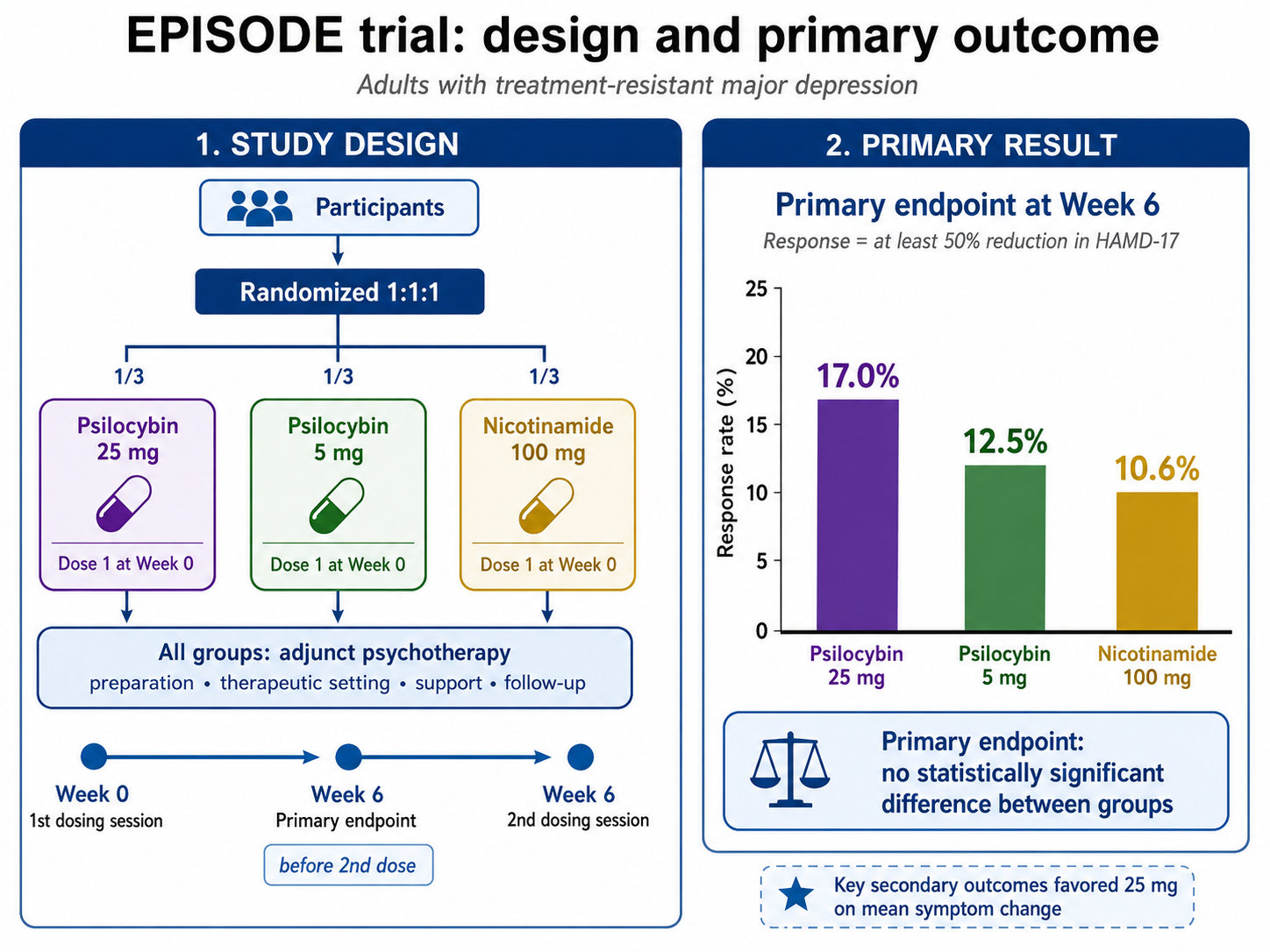
The primary endpoint was response at week 6, before the second dose. Response was defined as at least a 50% reduction on the Hamilton Rating Scale for Depression, HAMD17. Key secondary endpoints included response on the Beck Depression Inventory II and mean change from baseline on clinician-rated and self-rated depression measures.
The population also matters. These were not patients with mild depressive symptoms seeking a novel wellness intervention. They had treatment-resistant major depression, a condition defined by inadequate response to prior antidepressant treatment and often accompanied by long illness duration, recurrent episodes, comorbidity, suicidality, and functional impairment. In EPISODE, the mean duration since first major depressive disorder diagnosis was almost 14 years. Participants had tried a mean of more than five antidepressant agents over their lifetime, and nearly four in five had a current psychiatric comorbidity. Most participants were psychedelic-naive.
That clinical background should shape how the results are read. Treatment-resistant depression is not simply “more depression.” It is a mixed category that can include different biological pathways, psychological patterns, medication histories, trauma backgrounds, inflammatory states, personality features, and social determinants. A trial in TRD is therefore not only testing whether an intervention lowers a scale score on average. It is also testing whether a single treatment model can cut through a clinically heterogeneous population.
The Negative Primary Endpoint Cannot Be Brushed Aside
The most important discipline in reading EPISODE is to begin with the result the trial was designed to test. At week 6, 17.0% of participants in the 25 mg psilocybin group met HAMD17 response criteria, compared with 12.5% in the 5 mg psilocybin group and 10.6% in the nicotinamide group. The difference was not statistically significant on the confirmatory primary endpoint.
This is not a minor technical issue. Primary endpoints exist to prevent a trial from becoming a search for whichever result looks most favorable after the data are known. When the primary endpoint is negative, the strongest planned claim has not been established. For regulators, clinicians, and guideline writers, that distinction matters more than it often does in media coverage. It would therefore be misleading to present EPISODE as proof that psilocybin-assisted therapy is now established for treatment-resistant depression. It would also be misleading to say that the trial clearly validates the 25 mg dose as a standard clinical option. The central confirmatory outcome did not separate the full-dose group from the comparators.
At the same time, calling EPISODE a simple “failed trial” would also flatten the evidence. The choice of endpoint matters. A 50% response threshold is clinically meaningful, but it is also binary. It divides patients into responders and nonresponders even when individual symptom changes may be more gradual. Someone who improves by 40% may still be meaningfully better, especially in chronic TRD, but that person is counted as a nonresponder by the primary endpoint.
This is why the divergence between the primary endpoint and secondary outcomes is the core interpretive problem of the trial. The primary endpoint asks whether enough patients crossed a prespecified response threshold by week 6. Some secondary outcomes ask whether depressive symptoms, on average, moved more in one group than another. Those are related questions, but they are not identical.
The Secondary Signal Keeps Psilocybin in the Conversation
The secondary outcomes are where EPISODE becomes more interesting. On mean symptom change, 25 mg psilocybin showed greater reductions in depressive symptoms than both nicotinamide and 5 mg psilocybin. On HAMD17, the estimated difference at week 6 favored 25 mg psilocybin over nicotinamide and over the 5 mg dose. The self-rated BDI-II results were broadly aligned, showing stronger improvement with 25 mg psilocybin as well. This does not reverse the negative primary endpoint. But it changes the interpretation. The trial suggests that 25 mg psilocybin may have antidepressant effects in TRD, even if the response-rate endpoint did not produce a statistically significant confirmatory result. That is a narrower claim than the public conversation may want, but it is also a more scientifically defensible one.
The timing of improvement also matters. At week 1, HAMD17 response was higher after 25 mg psilocybin than after nicotinamide or 5 mg psilocybin. That is consistent with the broader interest in psilocybin as a potentially rapid-acting intervention. But rapid symptom movement is only one part of the story. In TRD, clinicians need to know whether improvement persists, whether it can be safely reproduced, and whether it translates into stable functional recovery.
EPISODE therefore supports a cautious middle position. It weakens exaggerated certainty, but it does not erase the antidepressant signal. In a field often divided between enthusiasm and skepticism, this is precisely the kind of result that should make interpretation more mature. The question is not “Was the trial positive or negative?” The better question is: which part of the trial is strong enough to guide the next study, and which part is too unstable to guide clinical practice?
The secondary signal is strong enough to justify continued research. It is not strong enough to justify overconfident clinical claims. That is the line the article forces the field to hold.
Blinding, Expectancy, and the Problem of Psychedelic Trials
EPISODE also shows why psilocybin is methodologically difficult to test. The study used an active placebo strategy and a low-dose psilocybin comparator, which are more sophisticated choices than a simple inactive placebo. However, the authors still reported that the design did not prevent functional unblinding sufficiently.
Functional unblinding means that participants or therapists may infer treatment allocation because the subjective effects of the intervention are too obvious. This is a major problem in psychedelic research. A full psychedelic dose can produce perceptual changes, emotional intensity, altered sense of self, and a distinctive acute experience. A comparator may be active in some sense, but still fail to mimic the full phenomenology of a psychedelic session.
This does not mean the observed improvements are “just placebo.” That would be too crude. Expectancy is not a magic switch that automatically explains all symptom change. The pharmacological effects of psilocybin, the acute psychological experience, the therapeutic setting, and the patient’s meaning-making process may all interact. In psychedelic-assisted therapy, the boundary between drug effect and context effect is especially porous. Still, functional unblinding complicates causal interpretation. If participants believe they received the active dose, they may expect improvement. If therapists believe the same, their behavior may subtly change. If the session feels profound, patients may reinterpret symptoms, life history, or emotional suffering in ways that affect self-report. Even clinician ratings can be indirectly influenced by patient presentation and therapeutic momentum.
The durability question is similarly unresolved. EPISODE provides useful short-term evidence, but it does not settle how long the effect lasts or how repeated dosing should be used. After the second dose, all groups had received 25 mg psilocybin at least once, making later between-group comparisons harder to interpret. The trial was also not powered to detect between-group effects in the second treatment phase. The authors observed improvement over time, but that does not prove a durable advantage of one initial dosing strategy.
For treatment-resistant depression, durability is not a secondary luxury. It is central. A rapid antidepressant effect is clinically meaningful, but only if the treatment model can define maintenance, relapse risk, retreatment intervals, monitoring, and patient selection. Without that, psilocybin remains a promising intervention model rather than a settled treatment pathway.
What EPISODE Changes in the Mechanism Debate
The most important consequence of EPISODE may be conceptual. It makes simple mechanism stories less persuasive.
One easy story is pharmacological: psilocybin acts primarily through serotonin 2A receptor agonism, produces neuroplastic changes, and thereby improves depression. Another easy story is skeptical: because psychedelic trials are hard to blind, the benefits are mostly expectancy and suggestibility. EPISODE does not allow either version to win.
The trial’s mixed result suggests that mechanism in psilocybin-assisted therapy may not be reducible to one layer. Pharmacology is almost certainly relevant. The 25 mg dose separated more clearly from comparators on several symptom-change outcomes than did 5 mg or nicotinamide. But the subjective experience, therapeutic support, expectancy, emotional processing, and patient interpretation of the session may also be part of the therapeutic pathway rather than mere noise around it. That creates a difficult question for psychiatry. In conventional drug development, context is often treated as something to control away. In psychedelic-assisted therapy, context may be part of the intervention. But if context is part of the intervention, trials need to measure it with the same seriousness as dose, adverse events, and scale scores. Preparation quality, therapist behavior, acute subjective effects, emotional breakthrough, expectancy, integration, and therapeutic alliance cannot remain background variables forever.
The heterogeneity of TRD makes this even more important. Some patients may respond because psilocybin disrupts rigid negative self-referential patterns. Others may respond because the acute session enables emotional processing that psychotherapy had not previously reached. Others may not respond at all, or may be destabilized. EPISODE does not identify a clear responder profile. It does, however, make that profile one of the field’s most urgent questions.
Future trials should therefore be larger, but not only larger. They should be more mechanism-sensitive. They need stronger blinding strategies where possible, independent raters, longer follow-up, predefined thresholds for clinically meaningful change, active comparators, standardized psychotherapy monitoring, and biomarkers or psychological measures capable of testing competing explanations. The next phase of psilocybin research in TRD should not merely ask whether the average score falls. It should ask why, in whom, under what conditions, and for how long.
Safety and Clinical Readiness
EPISODE also reinforces that psilocybin-assisted therapy is not a simple prescription model. Most participants tolerated treatment, but acute adverse events were common after 25 mg psilocybin. Many were expected psychedelic effects, such as altered perception, synesthesia, paresthesias, paranoia, or transient psychosis-like symptoms. These effects were generally acute and resolved the same day, but their clinical management requires trained supervision.
Safety signals deserve careful language. The trial reported suicidal ideation on dosing days in a small number of participants, somewhat more often after 25 mg psilocybin than after comparator conditions. Serious adverse events were rare, but some were considered related to 25 mg psilocybin. One participant developed hallucinogen persisting perception disorder with broader psychological destabilization. These findings do not mean psilocybin is broadly unsafe. They do mean that safety cannot be treated as an afterthought. This is especially true in TRD, where baseline suicidality and psychiatric comorbidity are common. A treatment that can produce intense acute psychological states may require careful screening, exclusion criteria, preparation, monitoring during administration, post-session support, and rapid access to psychiatric care if symptoms worsen. The clinical infrastructure is part of the intervention.
That is one reason EPISODE should not be read as a green light for casual use. The trial tested psilocybin in a structured, supervised, research setting. Its findings cannot be automatically transferred to unsupervised use, commercial wellness models, or loosely regulated therapeutic environments.
For clinicians and patients, the practical message is balanced. EPISODE does not establish psilocybin-assisted therapy as a standard treatment for treatment-resistant depression. It does not prove long-term remission, define ideal candidates, determine optimal retreatment timing, or show how psilocybin compares with ketamine, esketamine, ECT, TMS, augmentation strategies, or intensive psychotherapy. Those questions remain open.
But EPISODE also makes dismissal harder. A negative primary endpoint would have been enough to cool inflated claims. The secondary symptom-change signal prevents the field from walking away. This is exactly the kind of result that should move a research area from promotional enthusiasm toward sharper trial design.
The real change after EPISODE is not that psilocybin has been proved or disproved for treatment-resistant depression. The change is that the debate has become harder to conduct responsibly. The trial shows a possible antidepressant effect, but also exposes the interpretive weaknesses that future studies must solve. It points toward promise, but not readiness. It supports continued investigation, but not clinical certainty. After EPISODE, the question is no longer simply whether psilocybin can reduce depressive symptoms. The more important questions are narrower and more demanding: which patients are most likely to benefit, how much of the effect depends on dose versus psychological context, how durable the improvement is, how safety should be managed, and whether the treatment can outperform existing options under fair and rigorous conditions.
That is a less dramatic conclusion than the usual psychedelic headline. It is also a more useful one.
References
- Mertens, L. J., Koslowski, M., Betzler, F., Brand, M., Evens, R., Kärtner, L., Jungaberle, A., Jungaberle, H., Majić, T., Schmitz, C. N., Ströhle, A., Scharf, D., Spangemacher, M., Wolff, M., Assadi, Z., Bahri, S., Becher, L. V., Kirchen, N., Kulakova, E., … Gründer, G. (2026). Efficacy and safety of psilocybin in treatment-resistant major depression: The EPISODE randomized clinical trial. JAMA Psychiatry, 83(5), 448–460. https://doi.org/10.1001/jamapsychiatry.2026.0132